NDLTAP Helps Agencies Maintain Gravel Roads to Improve Safety and Cut Costs
Posted: Apr 23, 2026
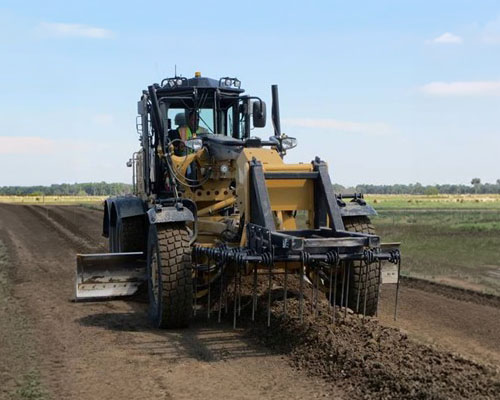 With more than 65% of North Dakota’s 106,000 miles of roadways surfaced in gravel, it is no wonder that gravel road maintenance is an important focus of the Upper Great Plains Transportation Institute’s ND Local Technical Assistance Program (NDLTAP).
“We live in a rural state with about twice the number of registered vehicles as licensed drivers, noted NDLTAP Director Bryon Fuchs. “Consequently, North Dakota doesn’t have the revenue or the traffic volume to pave many of its roadways.” In fact, only about 17,000 miles of the state’s roads are hard surfaced. Of the remaining 89,000 miles, about 70,000 are gravel surfaced.
Those gravel roads need maintenance to keep them in safe driving condition. Washboards, raveling, float, excessive dust, and loss of aggregate into ditches are all concerns. In the past two years, NDLTAP held 27 training events across the state, where 364 participants learned about gravel quality, motor grader operator training, pulling gravel shoulders, and dust control to help their local counties and townships address those issues.
“Training local road agencies the proper way to maintain gravel surfaced roads and the importance of using quality gravel is improving safety and saving taxpayers money,” Fuchs said. “And that’s a win-win for the traveling public in North Dakota.”
“NDLTAP training is an important addition to our county’s highway department,” Morton County Engineer John Saiki said. “Our employees always have positive comments after attending the training sessions. The training is current, relevant to their work, and presented in a positive, engaging way. We depend on NDLTAP to assist in making our employees safer, more productive, and valuable.”
The training also improves safety for employees as well as the traveling public, according to Corey Olson, director of member services for the North Dakota Insurance Reserve Fund. “Consistent training is a crucial component of risk management for all entities, regardless of their size,” he said. “It keeps employees, citizens, and visitors safe on our North Dakota roads. The motor-grader training provided through NDLTAP is top-notch, hands-on training that is critical for every county highway department’s risk management program. Claims consume time, money, and productivity, regardless of fault. The key is to keep those to a minimum, and this course (motor grader operator training) is a great way to achieve this.”
Fuchs said NDLTAP gravel road training focuses on three primary topics:
Well-Specified Gravel
Writing a specification for good quality gravel is the first step toward a quality gravel road surface. NDLTAP helps local agencies write a specification that calls for various aggregate sizes to create a dense material, fractured faces that allow the aggregate to interlock, and a plasticity index—or clay content—to bind everything together. Too much large size rock will result in “float,” causing vehicles to lose traction because the float acts like marbles on the roadway surface. Too much sand results in washboards. Fractured faces on the aggregate keep particles interlocked and prevents them from rolling around on the surface or ending up in the ditch.
Unlike a concrete or hot bituminous paved roadway, a gravel roadway has nothing to hold the aggregate together. Unfortunately, most ND gravel roadways do not have any clay in the gravel. Adding a specified amount of clay will reduce dust and washboards and reduce the amount of blading required. The clay helps hold the gravel together and helps the road shed water. However, a variety of clays in the state have different swell and/or adhesion properties, which affect how much or how little clay is desired in the gravel. That is where having a plasticity index specification comes into play. “Having fewer washboards helps drivers maintain control and reduces dust, improves visibility, and keeps fine material on the road and off nearby growing crops where it can cut production,” Fuchs said. NDLTAP assists counties and townships write plasticity index specifications that account for local materials and clays.
Proper Motor Grader Operation
Proper motor grader operation removes washboards caused by poor quality gravel and maintains the road’s correct slope to promote proper drainage. Insufficient slope causes water to pond on the roadway where it can saturate the surface, soften the subgrade, and cause potholes. Too much slope and water carries fines off the roadway into the ditch, eliminating the binder that holds the road together.
“The proper slope is 4% on a gravel roadway. The motor grader operator is trained to maintain the proper slope, which is very difficult to do,” Fuchs said. “Traffic tends to drive down the middle of the roadway and heavy loads push the gravel to the edges and pound out the middle of roadway, making a flatter profile that must be corrected by the motor grader operator.” Fuchs said NDLTAP also instructs operators to avoid blading the road when it is bone dry because it is a waste of resources. “Blading when it’s too dry can result in rutting, increased dust, and loss of gravel,” he said.
“We used to have some townships complain about how a few operators were blading their roads,” added retired Barnes County road superintendent Kerry Johnson. “We had NDLTAP come in and provide training to our operators. About a week later, those townships called and said the operators were doing a much better job on their roadways. NDLTAP training is a valuable resource to local agencies.”
Pulling Shoulders
Finally, NDLTAP has been providing training on how to pull the shoulders of gravel roadways to improve safety, cut costs, and conserve gravel. Over time, gravel tends to get pushed toward the shoulder and onto the inslope of the road. This widens the roadway, making it more difficult to maintain and requiring more passes from motor grader operators.
“Pulling shoulders brings the roadway back to the template it was designed and built to and recovers a valuable resource—gravel,” Fuchs said. “Having the proper roadway width improves safety and meets drivers’ expectations. In most North Dakota locations, gravel supplies are coming up short. Thus, recovering this material reduces the amount of new gravel an agency has to put down on the road, saving taxpayers money.”