NDLTAP Provides Bridge Training to Local Agencies
Posted: Nov 21, 2025
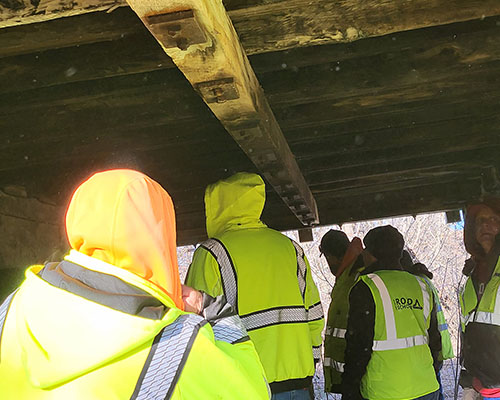 Local agencies across North Dakota are ensuring that bridges are safe and in service longer thanks to training provided by UGPTI’s North Dakota Local Technical Assistance Program (NDLTAP).
Currently, counties and cities in North Dakota own 2,954 bridges that are longer than 20 feet. Of those, 3.7% are closed and another 23.3% are load restricted, resulting in costs and delays for farmers, energy producers, and other road users. NDLTAP helps local agencies learn how to properly inspect, maintain, and repair bridges to assure safety and maximize their service life and safety.
Training sessions involve site visits to various bridges to help attendees understand bridge inspection reports that identify problem areas and maintenance needs, said NDLTAP Director Bryon Fuchs. Some of those maintenance items may look challenging to local agencies. However, NDLTAP offers solutions and technical advice on how to maintain those structures with their existing personnel.
“I am very thankful for all the continuing education trainings NDLTAP has offered over the years,” said Ramsey County Highway Superintendent Jason Kraft. “The NDLTAP staff will give you 100% support and share countless resources on the website, NDLTAP truly has a been a wonderful resource.”
The ND Legislature has recognized that the agriculture and oil industries drive North Dakota’s economy and that those industries depend on a reliable transportation infrastructure. “Going back to the oil boom in the late 2000s, additional monies have been provided to local agencies at all levels through legislation,” Fuchs said. “Permanent and one-time funding had been provided during each session, and finding ways to help local agencies with their infrastructure needs continues to be a hot topic.”
While local agencies appreciate the funding, Fuchs said, “not every bridge can be replaced immediately and not every bridge is on a well-traveled road or a road that is accessible year-round. Bridges that see low levels of traffic rank low on the priority list for replacement primarily due to the cost of replacement.”
NDLTAP’s basic bridge training course, which was offered this year in Mountrail County, ensures that the local agencies’ staff know the terminology for various bridge components. Each bridge over 20 feet long is required to be inspected by the ND Department of Transportation (NDDOT) at least every 2-years, or sooner depending on the condition of the bridge, with an inspection report detailing the condition of that bridge. Each component is rated good, fair, or poor based on a visual inspection to give the local agency responsible for the bridge an idea of its overall condition.
“You want a bridge to stay in the good or fair range as long as possible, preferably always in or near the good range,” Fuchs said. “Consequently, NDLTAP helps local agencies identify preservation and maintenance activities and techniques that need to be completed based on the bridge type. Those activities keep those bridges in better condition for a much longer time, reducing annual capital improvement costs across that agency.”
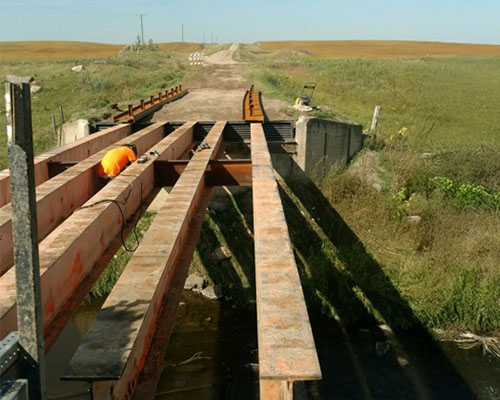 With age, extreme weather, and use, eventually every bridge will need some type of repair or rehabilitation. Repair and rehab strategies are determined by bridge type. Timber bridges can often be repaired or rehabbed by local agencies while steel or concrete bridges may require hiring an outside contractor.
“At some point, repair or rehabilitation is no longer cost effective or the load carrying capacity of that bridge can’t be maintained,” Fuchs said. “Often this creates a real challenge for local agencies because many of these bridges are on low-volume roads but provide a vital link for local industries and travelers. We work with those agencies to help them understand the available alternatives, which may be better options than doing a major repair or rehab. In many cases, those options allow the local agency to do the work.” A couple alternatives that are considered may be replacing that bridge with multiple pipes or a low water crossing.
NDLTAP’s advanced bridge class, offered this year in Richland County, provides more detail on repairing certain bridges. Topics covered are intended for repairs that local agencies can do with their own workforce. Fuchs noted that repairs and possible rehabilitation strategies can affect the load carrying capacity, positively and negatively, depending on the bridge type and the repair/rehabilitation needed for that structure.
During site visits in the advanced class, attendees review inspection reports that indicate certain bridge components are damaged and require repair or replacement, or if some form of minor to major bridge rehabilitation is needed.
“We not only help the local agency identify what components need to be replaced or repaired, but what other factors they should be considering,” Fuchs said. “During one site visit, we helped Walsh County understand the importance of examining some timber piling that had water standing adjacent to the abutment. Those timber piles turned out to be rotted and in need of repair. After the timber piles were repaired, embankment material and riprap were placed adjacent to the abutment and piles to keep water from pooling next to the timber abutment and piles, protecting them from future rot.”
NDLTAP also instructs local agencies on how to communicate with NDDOT regarding its bridges since that agency is responsible for bridge inspections. NDDOT also reviews the load-carrying capacity of state bridges that are 20 feet or longer. All repaired or rehabilitated bridges require another inspection to be completed prior to traffic opening and determine if the load carrying capacity is adequate or if they should be posted at a lower capacity.