Research Reports
Report Details
 Final Report
Abstract
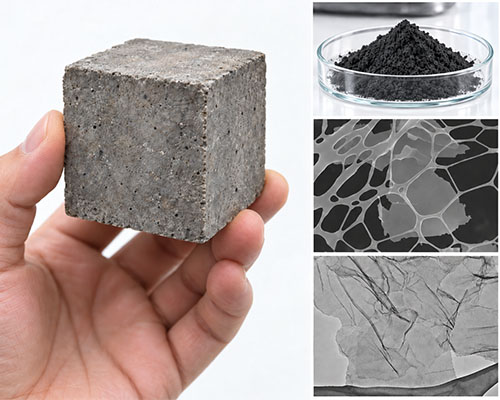 Winter road maintenance often relies on salts to melt snow and ice, but repeated salt use can damage concrete infrastructure and increase long-term maintenance needs. This project examined whether fly ash-based geopolymer mortar containing graphene nanoplatelets could be developed as a lower-cement, electrically responsive material for future snow-melting applications. Graphene nanoplatelets can help reduce electrical resistivity, but they tend to clump together in water and cementitious materials. This can limit their effectiveness and may reduce mortar performance. Before mixture development, the commercial graphene nanoplatelets were characterized using transmission electron microscopy, scanning electron microscopy, Raman spectroscopy, and X-ray photoelectron spectroscopy to verify the quality and baseline characteristics of the supplied material. The study then screened graphene nanoplatelet suspensions prepared with three surfactants, sodium dodecyl sulfate, Triton X-100, and polyvinylpyrrolidone. The suspensions were compared using electrical conductivity, pH, and visual dispersion stability over time. Based on this preliminary screening, sodium dodecyl sulfate was selected as the surfactant for the geopolymer mortar mixtures because it provided the most practical balance of dispersion stability and measured suspension behavior. The selected sodium dodecyl sulfate and graphene nanoplatelet system was then incorporated into fly ash-based geopolymer mortar at different graphene nanoplatelet contents and surfactant-to-graphene nanoplatelet ratios. The mortar mixtures were evaluated for workability, compressive strength, ultrasonic pulse velocity, and bulk electrical resistivity. The results showed that adding more graphene nanoplatelets did not automatically improve performance. Lower graphene nanoplatelet contents, especially 0.05% and 0.1%, provided a better balance between maintaining hardened properties and reducing electrical resistivity. Higher graphene nanoplatelet contents often produced less favorable results, which may be explained by poorer dispersion, particle agglomeration, or disruption of the mortar matrix. These findings help narrow the mixture designs that should be considered in future electrical-heating and ice-melting tests.
How to Cite
Shakouri, Mahmoud, and Mohammad Wais Sulaiman. Development of an Advanced Snow-Melting Geopolymer Mortar Utilizing Graphene, CTIPS-26-008. North Dakota State University - Upper Great Plains Transportation Institute, Fargo: Center for Transformative Infrastructure Preservation and Sustainability, 2026.