Research Reports
Report Details
 Final Report
 Abstract
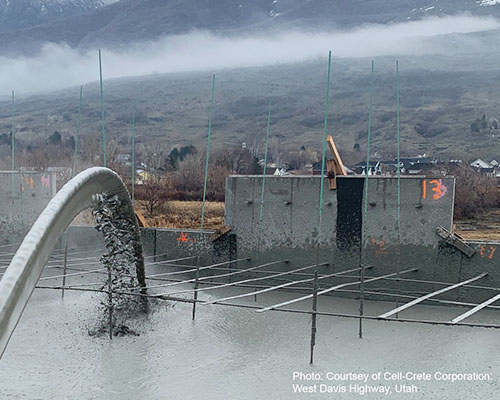 Lightweight cellular concrete (LCC) is increasingly used in geotechnical applications due to its low density and favorable mechanical behavior. Back-pressure saturated hydraulic conductivity tests were conducted on specimens treated with bentonite to prevent sidewall bypass. Micro-computed tomography (μCT) scans, performed at saturation levels ranging from 1.6% to 35%, were used to estimate pore size and water distribution in partially saturated LCC. A nonlinear regression model based on a unique test protocol was applied to evaluate long-term field saturation. Unconfined compression strength (UCS) testing indicated that specimens achieved nearly full long-term strength after 70 days, establishing 70+ days as the standardized curing period. Five partial saturation treatments (2.8–20.4% saturation) were applied to specimens used in a testing program that included resilient modulus (RM) tests, followed by UCS or drained triaxial compression tests. Simple and multiple linear regression (SLR and MLR) models were developed to predict initial and peak yield stresses, as well as Young's modulus, under both unconfined and confined conditions. An MLR model for RM was also established under varying stress states. Correlations between RM and strength parameters enabled the development of a surrogate RM estimation model for engineering design within the tested ranges.
How to Cite
Bartlett, Steven, and Daniel Seeley. Mitigation of Differential Settlement at Highway Bridge Approaches: Lightweight Cellular Concrete Technology, MPC-24-537. North Dakota State University - Upper Great Plains Transportation Institute, Fargo: Mountain-Plains Consortium, 2025.